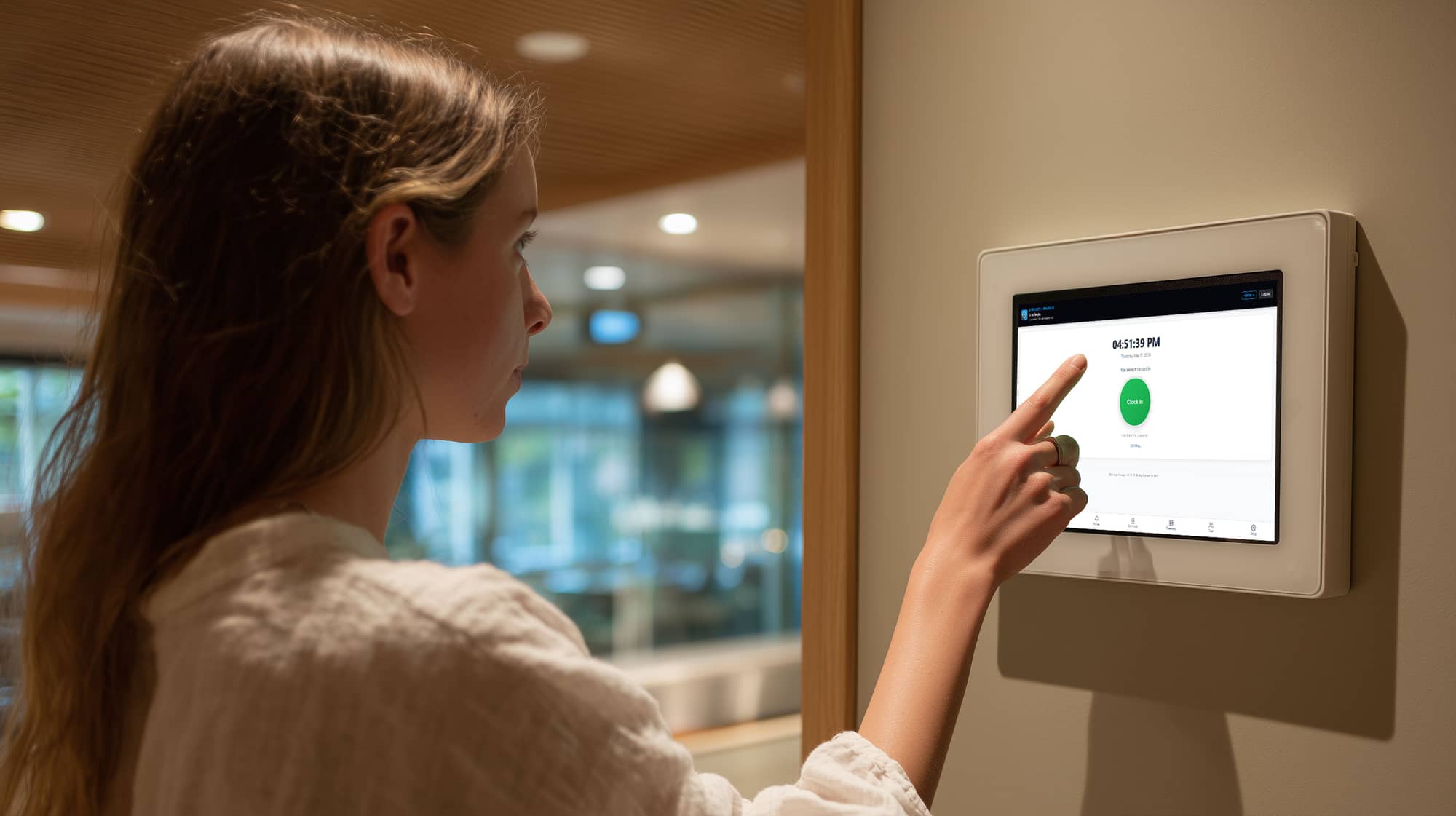
A staff member clocking in on a wall-mounted time-clock tablet at a commercial property
Employee Manager

Time and pay that match what actually happened.

Staff clock in at a shared tablet by the door or from their own phones on site. Every hour sorts itself into common-area maintenance, tenant-improvement work, or lunch as the day goes, so the payroll file at period end is already classified, already tenant-tagged, already done.

30-day trial No credit card Cancel anytime
Why it matters

Paper time cards lie, and payroll pays for it.

The hours on the card don't match the hours on site. Nobody remembers which tenant's space the crew was working in. And at period end you're sorting it all by hand — guessing at who worked where, hoping the numbers add up before the file goes out.

What's inside

Every punch verified. Every hour attributed.

A wall tablet and a phone time clock that block off-site and buddy punches, time that classifies itself as it's worked, and a payroll export your processor can read on the first try.

No off-site or buddy punches

Staff hold one button for three seconds to clock in or out, and when you've set a worksite radius the app checks their phone's GPS against it first. No buddy-punching, no clocking in from the parking lot down the street. A shift left open too long flags itself and locks the button until a manager clears it.

A shared wall-tablet clock

Mount one tablet by the door and the whole crew punches there — no phone needed. Each person taps their name, enters a four-digit PIN, and picks what they're working on. The tablet shows who's in, who's on lunch, and who's out at a glance. It holds no pay data and no PINs; every punch is verified on the server, and a lost tablet is shut off with one tap.

Hours that sort themselves

While they're on the clock, staff tap to switch between common-area maintenance, tenant-improvement work for a specific tenant, or lunch. Every switch timestamps a new segment, so by the end of the shift the hours are already split by category and tagged to the right tenant — no after-the-fact guessing.

See the dollars behind the hours

The labor cost report splits each person's pay across common-area maintenance, each tenant's improvement work, and owner-funded time — automatically, by share of clocked hours for salaried staff and hours times rate for hourly. When it's time to recover common-area costs or bill a tenant for work in their space, the labor side is already broken out in dollars, not just hours.

A notice the crew has to read

Get a message to the whole crew, right where they clock in — a schedule change, a safety reminder, a policy update. See who's seen it and who's acknowledged it, and for the ones that matter most, require an acknowledgment before they can start their shift. The latest notice shows on every clock screen automatically, on the phone and the shared tablet.

Staff see their own hours

Each person can pull up their own shift history for any recent pay period — total hours up top, a breakdown by category below, every shift listed with its in and out times. They check their own numbers before payroll closes, so you're not fielding "how many hours did I get?" the day the file goes out.

Manager timecard editing

Correct a forgotten clock-out or reclassify an hour in seconds. Edit clock times, or add, edit, split, and re-tag individual segments — with a reason on every change. The coverage readout warns you when the segments don't add up to the shift.

A full edit history

Every change to a timecard is kept — old value, new value, the reason, who made it, and when — newest first, right on the shift. When a wage question arrives, there's always an answer to "who changed this, and why."

Pay Periods you close with one click

Set your schedule — weekly, biweekly, semi-monthly, or monthly. Review the period's hours, then approve and lock it. Locking makes every timecard read-only across the system and unlocks the payroll export, so nothing can change after the file goes out. Need a fix? Re-open, correct, re-approve.

A payroll file that's ready to hand off

Close the period and export one CSV — one row per employee per work date, with category, tenant, and total hours, every hour already classified and tenant-tagged. There's nothing to sort by hand; hand it to your processor as-is.

An overtime watch

The overtime watch flags anyone who logged more than forty hours in a week spanning the period you're closing, and downloads as its own list — so a long week never slips past you into the payroll run.

Bring your old timesheets in

Back-fill months of paper or spreadsheet history from a template. Upload the file, match staff by email, and review a full preview with the row counts before anything is written — and undo an entire import in one step if something looks off.
Works better together

One staff clock, two ways it pays off across the suite.

Employee Manager runs perfectly well on its own — and where it touches the rest of the suite, the same hours start doing double duty.

A real example

One pay period, clock-in to payroll file.

How the hours travel from a phone on site to a file your processor can read — without anyone sorting them by hand.

  1. 1

    They clock in on site

    At the shared tablet by the door, or from their own phone — a three-second hold and, when you've set a radius, a GPS check.

  2. 2

    The hours classify themselves

    As the day moves, staff switch between common-area maintenance, a tenant's space, and lunch — each a timestamped segment.

  3. 3

    You review and fix

    Catch a forgotten clock-out or re-tag a segment — every edit logged with a reason.

  4. 4

    You approve and lock

    One click closes the period. Timecards go read-only and the payroll export unlocks.

  5. 5

    You hand off the file

    Download one CSV — every hour already classified and tenant-tagged — and send it to your payroll processor.

Pricing
$49 a month, standalone.

Standalone — or inside SquareKeeper Complete, all seven modules for $499/month. The first 30 days are free and there's no credit card to begin.

Common questions

Employee Manager, answered.

How does the geofence stop off-site clock-ins?

Turn it on for a property by setting a center point and a radius — 200 feet is the suggested default, and you can set it wider or tighter. Once it's set, a phone clock-in checks the phone's GPS against that radius before it accepts the punch: stand on the property and it works; try from down the street and it won't. Paired with the three-second hold, it ends both accidental taps and clocking in for someone who isn't there. (The shared wall tablet doesn't need it — it's already on site.)

How does the shared wall tablet work?

Mount a tablet by the entrance and pair it once from the Kiosks page — generate a code, type it on the tablet, done. From then on it shows your crew as a grid of names with a live in/on-lunch/out status. A person taps their name, enters their four-digit PIN, and either clocks in (picking what they're working on) or, if they're already in, switches category, starts or ends lunch, or clocks out. The tablet stores no pay and no PINs — every punch is checked on the server, so a misplaced tablet exposes nothing and is deactivated from the Kiosks page in one tap.

Tablet or phone — which should staff use?

Either, and they write to the same timecard. The shared tablet suits a crew that starts and ends at one spot; the phone suits people who move around the property, and it keeps the GPS check on clock-in when you've set a worksite radius. Someone can punch in at the tablet in the morning and switch category from their phone at lunch — it's one shift, however they touch it.

What does "tenant-improvement work" mean here?

It's the time your staff spend inside one specific tenant's space rather than on shared, common-area maintenance. When someone marks their time as tenant-improvement work, they pick the tenant from a list — so at period end you can see exactly how many hours went to each tenant versus the shared areas, which is what makes the labor side of your books add up.

What happens when I approve a pay period?

Approving locks the period. Every timecard inside it becomes read-only everywhere in the system, and the payroll export is enabled. That way nothing can change after the file goes out. If you find a correction afterward, re-open the period, fix it, and approve again — and the export re-enables once it's locked.

What's in the payroll export?

The file you pull when you close a pay period has one row per employee, work date, category, tenant, and total hours — every hour already labeled common-area maintenance, tenant-improvement work (with the tenant named), or other (lunch). A separate reports export adds pay rates and per-employee totals when you want them. Either way you hand it to your payroll processor as-is — no manual sorting.

How does the labor cost report split pay across tenants?

It takes the hours you've already tagged and turns them into dollars. For hourly staff it multiplies each segment by that person's rate; for salaried staff it spreads their pay by share of clocked hours. The result is each person's cost broken out across common-area maintenance, each tenant's improvement work, and owner-funded time. So when you go to recover common-area costs or bill a tenant for work in their space, the labor figure is already there in dollars — you're not back-calculating it from a timesheet.

Can I require staff to acknowledge a notice before they clock in?

Yes. Post a notice — a schedule change, a safety reminder, a policy update — and it shows on every clock screen automatically, on the phone and the shared tablet. You can see who's seen it and who's acknowledged it, and for the ones that matter most you can require an acknowledgment before a person can start their shift. The latest notice always surfaces first, so nobody misses it.

How does the overtime watch work?

It buckets hours by calendar week across the period you're closing and the one before it, and flags anyone over forty hours in any of those weeks — with the amount over forty and a downloadable list of just the flagged people. It's a heads-up before the payroll run, not a calculation of your specific premium rates.

Can a staff member work at more than one property?

Yes. Set which properties someone can access and they clock into whichever one they're standing at — the geofence is per property. Their hours roll up per property, so cost allocation stays accurate even for staff who move between sites.

We already have months of timesheets. Do we start over?

No — bring them in. Download the spreadsheet template, fill it from your paper or existing records, and upload. Staff are matched by email, rows for the same person and day become one shift, and you get a full preview with the counts before anything is written. If a batch looks wrong, undo the whole import in one step.

Do staff need their own login?

Staff use the same SquareKeeper account they sign in with everywhere else — there's no separate time-clock login to manage. People come from your central staff list, and what each person can see follows their role: owners and managers review and edit timecards and run payroll, while staff clock in and out and see their own hours.

Stop sorting hours by hand the night before payroll.

Start a free 30-day trial — no credit card. Bring your existing timesheets in from a template in minutes.